PENGARUH RASIO SUMBER LEMAK YANG BERBEDA TERHADAP KELANGSUNGAN HIDUP DAN PERTUMBUHAN BENIH IKAN KELABAU (Osteochilus melanopleurus)
Keywords:
growth, Kelabau, lipid, specific growth rate, survival rate.Abstract
Kelabau fish is a type of freshwater fish that grows slowly even though it is fed adequate
nutrition. The research was conducted to analyze the survival, total length growth, weight
growth, and specific growth rate of kelabau fish fed with different ratios of lipid sources.
This study used a completely randomized design (CRD) with five treatments and three
replications. The treatments were A (100% fish oil and 0% corn oil), B (75% fish oil and
25% corn oil), C (50% fish oil and 50% corn oil), D (25% fish oil and 75% corn oil), and E
(0% fish oil and 100% corn oil). 20 kelabau fish 40 L-1 volume container were reared for 45
days with a semi-closed water circulation system. Feeding is done twice a day at satiation.
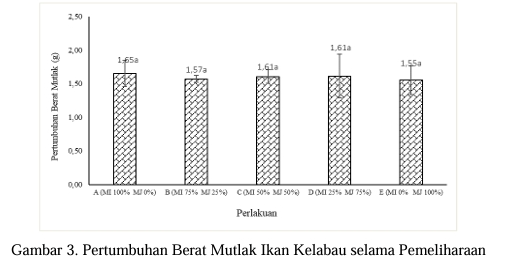
The results showed that the ratio of different lipid sources had an effect on the total length
growth of kelabau fry (P<0.05) but had no effect on the survival rate, absolute weight growth,
or specific growth rate of kelabau fry (P > 0.05). Fish consuming diet C (50% fish oil and
50% corn oil) had the longest growth. Fish that consumed diet C also had relatively better
survival rates and specific growth rates compared to groups of fish that consumed other
feeds.